Why Bến Tre is Vietnam's coconut region, and what changed in 2025
In Vietnam, Bến Tre is simply xứ dừa, the coconut land. Since 1 July 2025 it is no longer a province on the map. The coconut did not move. The paperwork did, and a buyer should know which of the two they are looking at.
Three islands of river silt
Bến Tre sits at the mouth of the Mekong, where the river splits into several branches before it reaches the sea. The land between those branches is three long islands, or cù lao: An Hóa, Bảo and Minh. They were built from silt the river dropped over thousands of years. Smaller islands silted together until the channels between them closed.
The ground is flat and low, on average one to two metres above sea level. The soil is a silty clay. It is the last stop for the river's sediment before open water, and coconut has long been the main perennial crop here. According to Vietnam's Ministry of Industry and Trade, Bến Tre accounts for most of the country's coconut area.
Why coconut, and not something else
The short answer is water. The tide here is semi-diurnal: it comes in and goes out twice a day, through every canal. A coconut grove in Bến Tre is not a field. It is a grid of raised beds with a ditch between each pair. Growers plant on the bed and use the ditch for three things:
- Silt. The ditches are dredged and the mud goes back onto the beds. It is how the soil stays fed without being ploughed.
- Fresh water. In the rainy season the ditches hold fresh water. In the dry season, when the canals outside turn brackish, that stored water goes back onto the palms.
- Transport. Many groves are easier to reach by boat than by road.
Durian and pomelo are grown here too, but they need more protection from salt in a dry year. Coconut is the crop this landscape was organised around. How the brackish water shows up in the taste is in a separate piece.
Most of it is not drinking coconut
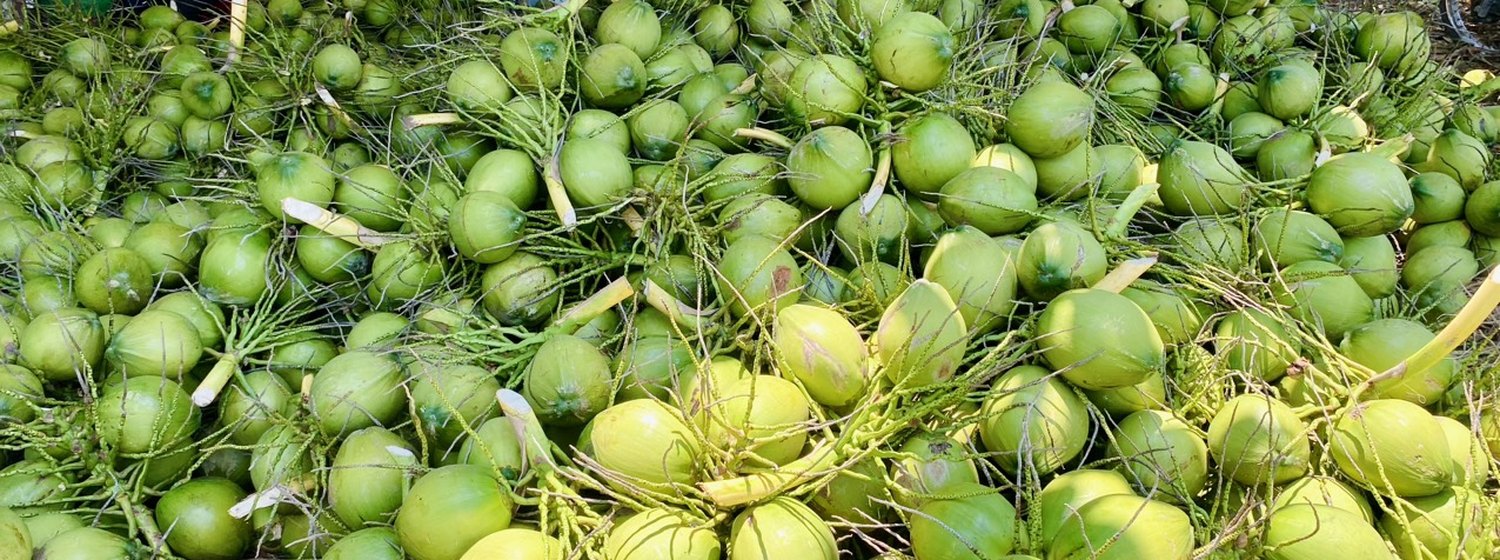
This is the part that matters for supply. The Ministry of Industry and Trade puts drinking varieties at a little over 20% of Bến Tre's coconut area. The rest are other varieties, such as the tall dừa ta palms that green xiêm was once planted in between, as a side crop for the household.
So "the coconut region" does not mean an unlimited supply of young coconut. The xiêm groves are the smaller share, they are spread across many family plots, and their fruit is cut young, by hand, every few weeks. Volume comes from relationships with many growers, not from one big plantation. That is also why traceability has to be built at grove level. Nobody can reconstruct it later from a truck of mixed fruit.
The name is protected
On 26 January 2018 Vietnam's Intellectual Property Office granted geographical indication No. 00063 to dừa uống nước Xiêm Xanh "Bến Tre", green xiêm drinking coconut from Bến Tre (Decision 298/QĐ-SHTT). The managing body named at the time was the Bến Tre Provincial People's Committee. The protected area is Bến Tre city and eight districts: Châu Thành, Chợ Lách, Giồng Trôm, Mỏ Cày Nam, Mỏ Cày Bắc, Thạnh Phú, Ba Tri and Bình Đại.
The registration describes a small fruit with a green skin and water that tastes sweeter than the same variety grown elsewhere, and ties that to the islands' soil and the bed-and-ditch method above.
What changed on 1 July 2025
Two decisions of the National Assembly redrew the map:
- Resolution 202/2025/QH15 merged Bến Tre, Trà Vinh and Vĩnh Long into a single province named Vĩnh Long, with an area of 6,296.20 km². The new provincial government started work on 1 July 2025.
- Law 72/2025/QH15 on local government ended the district level across the country from the same date. Vietnam now has provinces and communes, nothing in between.
The result: the eight districts named in the geographical indication no longer exist as administrative units, and the province that managed the registration has been merged into another. The ground those names describe is exactly where it was.
What a buyer should update
None of this changes the fruit. It does change what is printed on documents, and documents that do not match each other are what slow a shipment down. Four checks:
- Supplier address. Packhouses in the former Bến Tre now have addresses in Vĩnh Long province, usually with a new commune name. Make sure your supplier file, your FSVP records and the documents on the shipment all carry the same address.
- Certificates. Phytosanitary and origin certificates issued after July 2025 show the new province. If your system matches documents against an old address, flag it before the first container, not at the port.
- "Bến Tre" on the carton. As a description of where the fruit grew, it is still accurate. If a supplier presents it as the geographical indication, ask who authorised that use and which body manages it now.
- Grove-level records. A grower code tied to a specific grove survives any change of province name. A province name on its own never told you much.
Sources: National Assembly Resolution 202/2025/QH15 of 12 June 2025, Article 1(20) and Article 2; Law on Organisation of Local Government No. 72/2025/QH15, Article 51 (Official Gazette No. 807+808, 24 June 2025); Ministry of Industry and Trade, "Dừa xiêm xanh – đặc sản nổi tiếng của tỉnh Bến Tre", moit.gov.vn. This is a plain-language summary, not legal advice.
Where we stand. A grower's export company rooted in Bến Tre, founded by someone born in Cái Mơn, Chợ Lách. Records are kept per grove and per cycle, and every lot can be traced from its lot number back to the grove, whatever the province is called.